Why Crypto Traders Are Exploring Event-Driven Market Platforms
By Lidia Yadlos

Crypto trading has always moved fast, but the market is evolving beyond simple token speculation. Traders focused on Bitcoin, Ethereum, or the momentum of other cryptocurrencies are increasingly exploring event-driven platforms tied to real-world outcomes.
Today, Federal Reserve decisions, ETF approvals, sports results, inflation data, and even cultural moments have become tradable opportunities in modern event-driven markets.
That shift reflects more than curiosity. Crypto traders want faster, more actionable information, better ways to manage risk, and new sources of volatility in a market where traditional price moves can feel crowded and increasingly correlated.
Real-Time Speculation Beyond Asset Prices
Crypto traders are no longer limited to asking whether a token will rise or fall. Event-driven platforms allow participants to trade probability itself, creating new ways to capitalize on information, timing, and market-moving events.
Traditional crypto trading revolves around price charts, while event-driven markets let traders speculate on whether specific events will happen. These contracts typically use binary “Yes” or “No” outcomes priced between $0.00 and $1.00 based on market probability.
The appeal is clear. Traders with strong insight or faster information can capitalize beyond traditional token exposure, even during slower crypto periods when Bitcoin prices remain relatively flat while major announcements still drive volatility.
Platforms expanding access to probability-based markets are helping push the category further into the mainstream. FanDuel crypto betting reflects how event-driven trading now extends beyond token prices into crypto-related outcomes and broader real-world events.
Precision Positioning & Macro Hedging
Volatility attracts traders, but uncontrolled exposure pushes many away. Event-driven platforms offer more precise positioning than traditional futures or spot markets, allowing traders to hedge specific concerns without shorting the broader crypto market.
Event contracts allow traders to isolate specific market developments instead of taking broad positions on Bitcoin or the wider market. Unlike perpetual futures, they settle at fixed outcomes without liquidation pressure or funding fees.
The structural differences are becoming increasingly attractive to traders seeking clearer parameters and more controlled exposure:
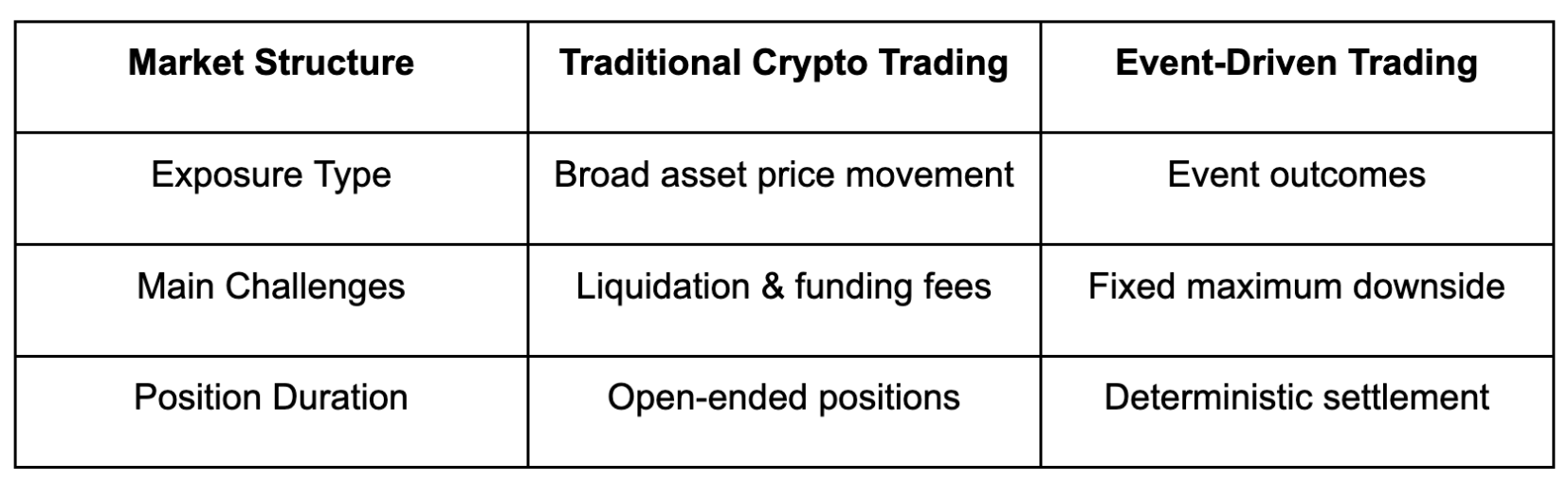
That structure feels cleaner to many traders. Maximum downside is known upfront, and positions aren’t vulnerable to sudden liquidation cascades caused by market spikes. That added clarity can make volatile markets easier to navigate.
Uncorrelated Opportunities in a Highly Correlated Market
Crypto markets often move together. When Bitcoin drops sharply, altcoins usually follow, making diversification difficult when most assets respond to the same macro sentiment.
Event-driven platforms offer an alternative by creating opportunities tied to independent catalysts rather than broad market direction. A trader can capitalize on an inflation report or regulatory announcement even if crypto prices remain relatively flat.
That flexibility becomes especially valuable during slower market cycles. Traders no longer need extreme token volatility to stay active, since major economic and industry developments can still drive movement across event-driven trading platforms and markets.
Many traders now view event-driven markets as information rather than asset trades. Success depends less on broad momentum and more on understanding specific developments before the wider market fully reacts to major breaking events.
Community Sentiment as the Engine of Trade
Crypto culture already thrives on narratives, crowd conviction, and online momentum. Event-driven markets turn that energy into measurable financial signals backed by real capital rather than passive online speculation.
Social media opinions are easy to post, but prediction-style markets require participants to commit money to support their convictions. That difference gives probability shifts more weight than trending hashtags or viral commentary across crypto trading communities.
Traders watch those movements closely because they reveal how the market collectively interprets incoming information. Rapid changes in sentiment can quickly reshape probabilities tied to regulation, macro developments, or major crypto events.
Crypto communities have always moved quickly around narratives across Discord, Telegram, and crypto-focused X conversations. Event-driven markets simply financialize that behavior, turning real-time discussion into actively traded market positions.
The Appeal of Instant Market Repricing
Order books on prediction-style platforms can adjust within seconds as new information enters the market. In some cases, probability shifts appear before mainstream media fully reacts, turning event-driven markets into real-time sentiment indicators.
Traders monitor those movements not just for profit opportunities, but for clues about how informed participants are interpreting incoming developments. Rapid probability changes often signal shifting sentiment long before broader narratives fully form.
Hard deadlines can create explosive repricing moments around:
CPI inflation releases
SEC rulings on crypto regulation
Major corporate earnings reports
Election and policy developments
High-profile protocol launches
A single announcement can instantly swing probabilities and create rapid trading opportunities. Traders who thrive on momentum, volatility, and fast reactions naturally gravitate toward these environments during major market-moving news cycles.
Open Participation in Transparent, Borderless Markets
Accessibility remains one of crypto’s defining cultural values, and event-driven trading platforms align closely with that mindset. Many traders are drawn to systems that feel more open and flexible than traditional financial infrastructure.
Event-driven platforms allow broader participation in markets once largely limited to institutional players or specialized derivatives desks. That accessibility is helping prediction-style trading expand well beyond early crypto-native communities.
Transparent settlement mechanisms also play a major role in adoption. Reputable platforms rely on clearly defined resolution systems, public pricing data, and verifiable outcomes to maintain trust among participants across rapidly evolving digital trading ecosystems.
Crypto traders already value transparency, peer-to-peer participation, and open access. Event-driven platforms naturally fit within that broader ecosystem philosophy while creating new ways to engage with real-world events.
Trading Information Instead of Just Assets
Crypto trading is becoming increasingly tied to information flow, probability, and timing rather than simple asset ownership. Event-driven platforms reflect that shift by giving traders new ways to engage with volatility and real-world developments.
Traditional crypto trading is not disappearing. Bitcoin and digital assets remain central to the ecosystem, but traders are clearly expanding their strategies beyond simple token exposure.
Markets built around events, sentiment, and rapid repricing are becoming a growing part of modern speculation, especially for traders seeking faster-moving and less correlated opportunities.
Published on Blockster
Why Crypto Traders Are Exploring Event-Driven Market Platforms